
Marty Supreme: Timothée Supreme, New York City Supreme
Review of Marty Supreme
TITLE: Marty Supreme / DIRECTOR: Josh Safdie / SCREENWRITERS: Josh Safdie, Ronald Bronstein / CAST: Timothée Chalamet, Gwyneth Paltrow, Odessa A’zion… / DURATION: 149’ / COUNTRY: United States, Finland / YEAR: 2025
With Good Time (2017), the brothers Benny and Josh Safdie departed filmmaking independence to join the American auteur establishment, a transformation Uncut Gems (2019) cemented. Last year marked their directorial split: Benny directed an MMA wrestler biopic (The Smashing Machine) while Josh continued what the Safdies seemed destined to do — portray the soul and character of their New York City (NYC). The buzz, the risk, the never-ending hustle of Uncut Gems and its characters elevate in Marty Supreme, turning the film into a portrait of the city that borders on fantasy, with its title character (Timothée Chalamet, who also produced) serving as an embodiment of NYC itself.
The Marty Supreme marketing campaign was larger than life — a gradual build-up of the grand, stubborn, and impossible to overlook. A fake leaked meeting where Timothée pitches a marketing strategy with 2010s artist-formerly-known-as-Kanye-West-level conviction. Susan Boyle singing Marilyn Monroe-style “Happy Birthday” to Timothée in a Marty Supreme jersey jacket. Timothée giving rebirth to white rap in a duet with a balaclava-masked UK artist EsDeeKid. Finally, a day before the US theatrical release: Timothée’s close-up as a drone pulls back to reveal him atop the Las Vegas Sphere transformed into a giant orange ping-pong ball inscribed MARTY SUPREME *** DREAM BIG.
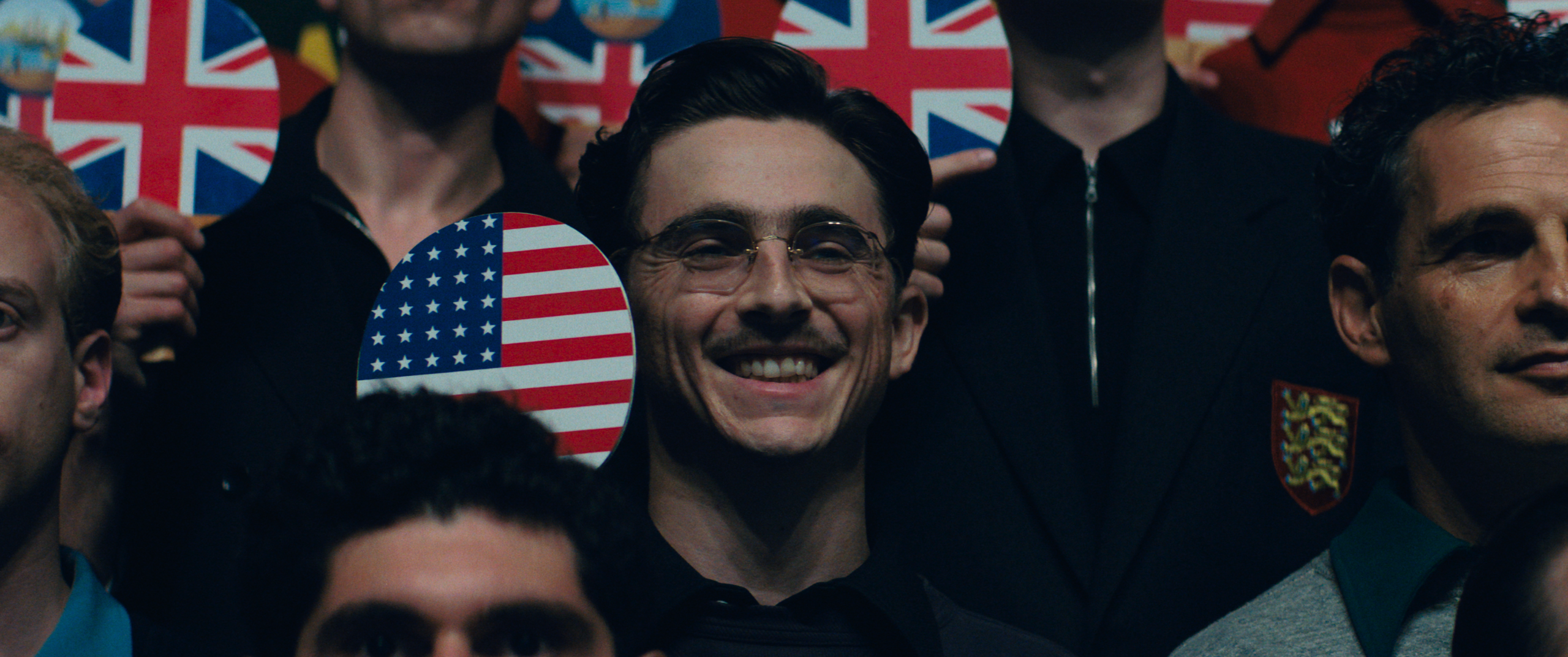
The film delivers on that promise, albeit visually as an antipode to the Zoomer generation style campaign — a period production, set in gritty and elegant 1950s, colored with 50 shades of brown. Marty, a character inspired by the real-life professional table tennis player and hustler Marty Reisman, is a twenty-something, acne-scarred, beetle-eyed Jewish kid living with his mom, claiming to be a table tennis prodigy. He works in his uncle’s shoe shop, collecting money for an overseas trip to the British Open, where he’ll win big. He’s fast, determined, with firm conviction in his ability, and no strategic plan — but a plan isn’t necessary because it just will work out. Timothée embodies Marty’s conviction, recently publicly claiming his own greatness, and like his character, he transcends his petite posture and tiny mustache through sheer confidence, in what becomes art imitating life or the other way around.
This confidence guides every aspect of Marty’s existence, not just his sports performance, which, surprisingly, is successful. He’ll seduce a twenty-years-older ex-Hollywood star turned NYC socialite (a sophisticatedly confused Gwyneth Paltrow), strike a deal with her businessman husband, get accommodated in a presidential suite at the Ritz, etc. The film spans a seemingly never-ending sequence of such and alike events, of alternating successes and failures, life’s ebb and flow, where flow can propel you to a spotlight visible from space, and ebb can put a bullet in you. These events are merely dots on Marty’s road, on NYC’s road. Ultimately, this is a road film where NYC is both the road and the destination, and Marty is a vehicle that gets rebuilt along the way.
Writer-director Josh Safdie and co-writer Ronald Bronstein (Good Time, Uncut Gems), who also served as editors, together with cinematographer Darius Khondji (Amour [Michael Haneke, 2012], Uncut Gems, Mickey 17 [Bong Joon-Ho, 2025]), infuse the film with the propulsive stress familiar from Uncut Gems — rapid cuts, overlapping dialogue, yelling, frames densely populated with characters both central and incidental. Safdie deploys real-life figures: quirky NYC Italians as small-time hoods, the YouTube-famous radio-voiced homeless man working at an underground ping-pong parlor, a Shark Tank judge as the businessman, Tyler, the Creator as Marty’s partner in a ping-pong betting scheme, a professional Japanese deaf table tennis player as Marty’s final opponent. These aren’t stunt cameos; they’re essential texture. Characters positioned deep in the background deliver pointed, witty commentary on the foreground drama, like for example when Marty negotiates with the actress’s husband after her disastrous theater premiere, and an onlooker remarks: “This might be more dramatic than the play!”
The film’s humor is laced with provocation as Safdie includes jarring or politically incorrect jabs. In doing so, he often drifts toward a stranger, more dreamlike territory. Géza Röhrig (Son of Saul [László Nemes, 2015]), playing Marty’s aging rival Kletzki, recounts a concentration camp memory: covering himself in honey from a discovered bee nest, then letting starving inmates lick his body clean. Safdie films this surprisingly sensually, tongues and all, that plays as both grotesque and tender. The fantastical strain continues in a montage of Marty and Kletzki’s globetrotting tour that openly courts Wes Anderson comparisons: symmetrically composed shots of the pair in pastel pink pajamas playing ping-pong with kitchen pots in a shadowy Sarajevo gymnasium, or a sleuthing camera discovering Marty casually chipping stone from an Egyptian pyramid. The table tennis sequences themselves become showcases with trick shots, and the audience’s heads turn left and right in a hypnotizing momentum. Meanwhile, back in NYC, crimes of escalating violence, fraud, assault, murder pass without consequence or investigation, operating on cartoon logic.
This combination of grit and fantasy, realism and absurdism, shouldn’t cohere. That it does is a testament to Safdie’s vision of NYC as a place where anything can happen and nothing quite matters, where hustle trumps morality and momentum replaces meaning — a NYC Supreme, carried on the shoulders of Timothée Supreme.
Photo Credit: Blitz Film and Video Distribution Promo.